Landfill rules have improved a lot over the years. Since the Control of Pollution Act in 1974, new engineering standards and regulations have greatly changed how waste is managed. Because of ongoing pollution risks from old landfills, the Parliamentary Office of Science and Technology (POST) is researching how big this problem is. If you want to contribute to this research, the deadline to get involved is 5 September 2025. More information is available if you’re interested. Management of legacy landfill pollution consultation
This is the first of our articles about risks from legacy landfills and in this case how climate change can affect it.
The UK’s Coastline and Pollution Risks
The UK has one of the longest coastlines in Europe—over 17,000 km—surrounded by the Atlantic Ocean, North Sea, Irish Sea, and English Channel. But climate change is making this coastline more vulnerable to erosion due to rising sea levels and more extreme weather.

https://www.chroniclelive.co.uk/news/north-east-news/45m-clean-up-operation-lynemouth-20775462
Landfills on the Coast
There are about 20,000 old landfill sites in England. Over 1,200 of these are on the coast in areas at risk of flooding. Many of them contain hazardous waste like chemicals, sludge, and industrial materials. Some of these sites could start eroding by 2025 if not properly protected.
Historically, landfills were placed in low-cost, flood-prone areas near towns, rivers, and cities. Back then, there were no rules about how waste was dumped, so many sites have no protective layers or monitoring systems. Even though these landfills are now closed, the waste remains—and could leak into the environment.
Protecting the Coast
To protect against erosion, local authorities use Shoreline Management Plans (SMPs). These plans outline how to manage the coast over short (0–20 years), medium (20–50), and long-term (50–100) timeframes. The four main strategies are:
- Hold the line – Build or improve sea defences to keep the shoreline where it is.
- Advance the line – Create new defences further out to sea.
- Managed realignment – Let nature take its course but manage where and how the coast changes.
- No active intervention – Do nothing and let nature take its course.
Most landfill sites use the “hold the line” approach to prevent pollution, especially since 30% are near sensitive environments like estuaries. But this is costly and can cause other areas to erode faster. Moving the waste is often too expensive and unsustainable due to limited landfill space. “Managed realignment” may be a better long-term solution.
Funding Challenges
Funding is critical. To get support, sites must show they pose a risk to people, nature, or property. The main funding source is the Flood and Coastal Erosion Risk Management (FCERM) fund, often combined with money from local councils or developers.
Porchester Quay (Portsmouth)
At Porchester Quay on Paulsgrove Lake, new ‘hold the line’ sea defences are being built. These include a sheet piled wall designed to protect against a 1-in-200-year flood.
Funding for this was possible because 400 homes and 100 businesses are currently at risk from flooding, and by 2115, that number could rise to 662 homes and 141 businesses. The project is funded by a mix of government grants (FCERM GiA), private developers, and local contributions.
Cam Bay and Birdwood Grove
Nearby, old landfill sites at Cam Bay and Birdwood Grove are not protected. These areas, now used for recreation, took in household and commercial waste in the 1970s—including plastics, bricks, and glass.
Erosion has already exposed plastic waste and debris on the shoreline. Testing shows the leachate (liquid pollution) from these sites contains high levels of harmful metals and chemicals.
There are only minimal, deteriorating defences like sandbags and old concrete blocks. These sites are next to protected coastal habitats (SSSI, SPA, Ramsar), so their erosion could seriously harm the environment and local communities. More research is needed to find proper management solutions and secure funding.

Lynemouth Beach (Northumberland)
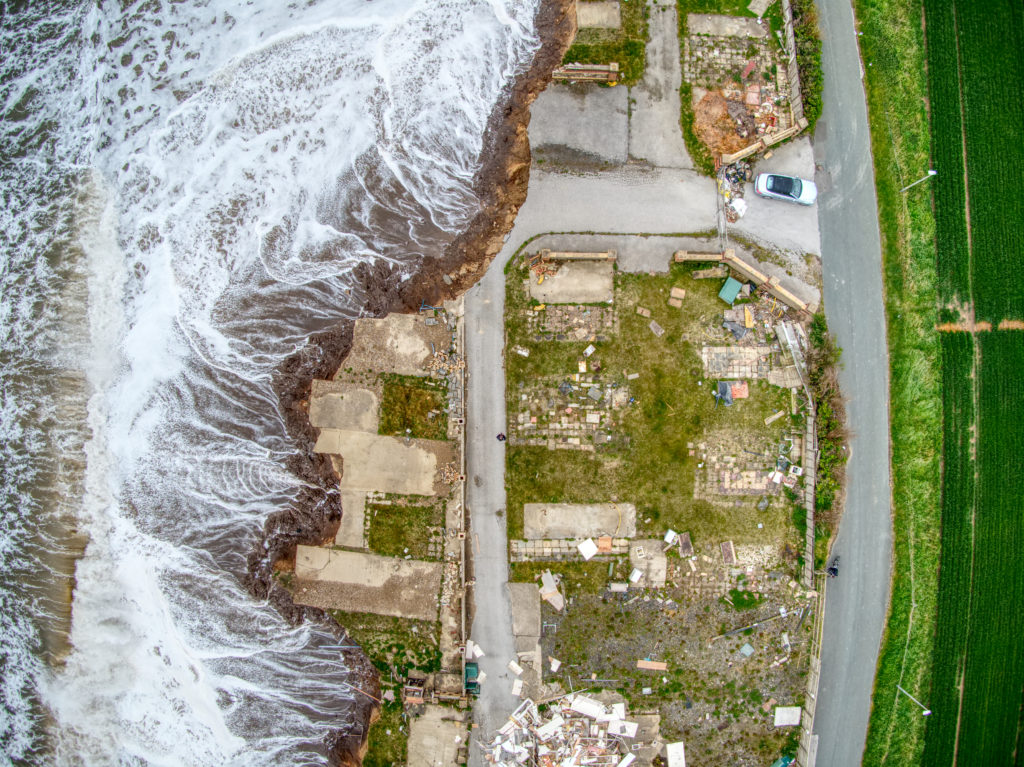
On the northeast coast of England, Lynemouth Beach has old landfill sites containing about 30 million tonnes of coal mining waste from Ellington and Lynemouth Colliery. The cliffs made of this waste are eroding, causing pollution like spoil, pipes, oil, and other materials to fall onto the beach.
In response to public concerns, the local council has set aside £5 million for a clean-up project which has now resulted in the processing of 95,000 tonnes of colliery waste resulting in 1000 tonnes of hazardous and non hazardous material being removed.
While this work is underway, the council is also carrying out regular beach inspections, safety checks, and some remedial work to protect the public.


Conclusion
Coastal erosion is revealing the UK’s polluted past and putting local habitats, properties, and people at risk. While Shoreline Management Plans provide guidance, many landfill sites don’t qualify for major funding and are left with only temporary fixes.
To help homeowners understand their risk, Groundsure’s Avista and Homebuyers reports now include ClimateIndex. This tool shows how erosion might affect a property in 1, 5, and 30 years and explains the local shoreline management strategy—giving people clearer insight into future risks from climate change.
For more information on ClimateIndex™ contact us on 01273 257 755 or email [email protected]
References:
Brand J.H.,Spencer K, O’shea F, Lindsay J (2017) Potential pollution risks of historic landfills on low-lying coasts and estuaries: Potential pollution risks of historic landfills. Wiley Interdisciplinary Reviews: Water 5(1)
Beaven, R. P., Stringfellow, A. M., Nicholls, R. J., Haigh, I. D., Kebede, A. S., and Watts, J. (2020). Future challenges of coastal landfills exacerbated by sea level rise. Waste Manag. 105, 92–101. doi: 10.1016/j.wasman.2020.01.027
Hancock, Michaila. (2020) Detailed ground investigations to start at Lynemouth historical landfill site. Ground Engineering. Available online at: https://www.geplus.co.uk/news/detailed-ground-investigations-to-start-at-lynemouth-erosion-landfill-site-11-08-2020/ (accessed November 11, 2022).
Nicholls Robert J., Beaven Richard P., Stringfellow Anne, Monfort Daniel, Le Cozannet Gonéri, Wahl Thomas, Gebert Julia, Wadey Matthew, Arns Arne, Spencer Kate L., Reinhart Debra, Heimovaara Timo, Santos Víctor M., Enríquez Alejandra R., Cope Samantha. (2021) Coastal Landfills and Rising Sea Levels: A Challenge for the 21st Century. Frontiers in Marine Science. 8.
Wadey, M. P., Kermode, T., Cope, S., and Neill, S. (2019). Landfill Sites at Risk of Flooding and Erosion within the SCOPAC Area. Southern Coastal Group and SCOPAC. Available online at: https://scopac.org.uk/research/scopac-landfills-study/ (accessed November 11, 2022).