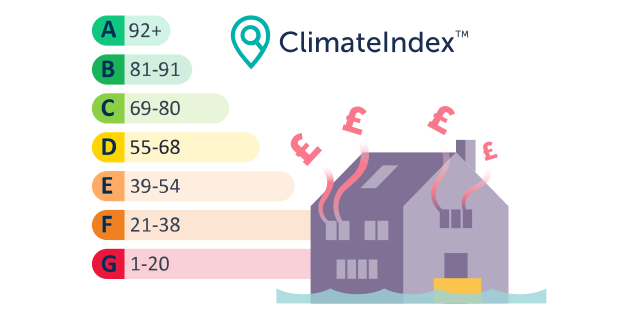
Location: Thorpeness is a seaside coastal village on the east coast of Suffolk, and it lies within the Suffolk Coast and Heaths AONB - Area of Outstanding Natural Beauty.
Background: Coastal erosion is increasingly affecting UK towns and communities, particularly in Thorpeness, Suffolk, where accelerated erosion is causing homes to be lost to the sea. Recent reports state that the village is being ravaged by the sea - with coastal erosion occurring at a faster rate than anyone expected. As a result, cliffs are being undercut and beaches are becoming narrower, leaving properties increasingly exposed. In some cases, homes have become structurally unsafe and have had to be demolished, with others collapsing into the sea.
The challenge to the community:
Since the 1970s, East Suffolk Council has attempted to manage erosion, especially at the northern end of Thorpeness. However, rising sea levels and more frequent storms have weakened defences. This has resulted in lowered and narrowing beaches, cliff exposure, and has enabled the sea to reach the sea defences and the foot of the cliffs, causing further erosion.
The result? Various properties have been now removed – after they reached critical safety levels between 2021 and January 2026
A real-life example:
Suffolk has witnessed some of the fastest eroding coastlines in Europe, with around 2,500 homes at direct risk. Data shows a trend of sea level rise with higher tides, a frequency of flooding within some low-lying areas and coastal erosion, resulting in narrow beaches and steepen. Council management strategies include: the installation of defences between 2010 and 2012, which includes gravel-filled geo-bags and a 35-metre emergency rock revetment – designed to slow erosion and protect key areas.
Unfortunately, following a recent reappraisal by East Suffolk Council, further protection from the scheme is deemed unaffordable, due to the rising cost of construction, design and materials. Read more here.
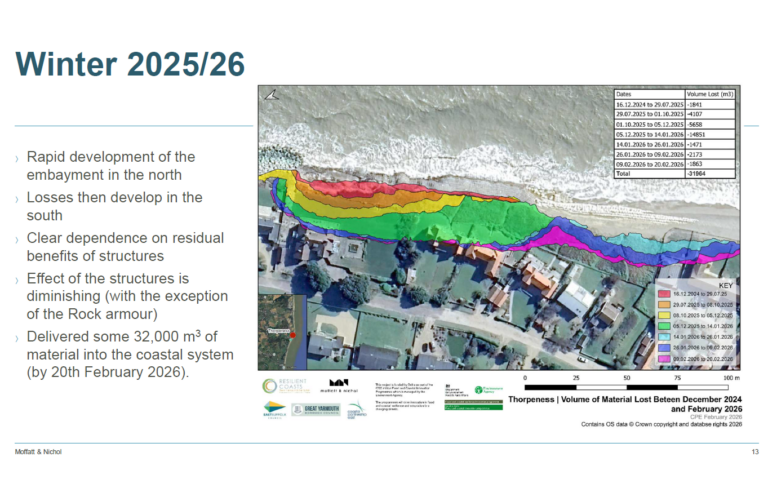
Below: The data shows the scale of erosion between December 2024 and February 2026.
*Credit: East Suffolk Council
The impact of this includes:

- Loss of homes and displacement of the residents
- Uncertainty and stress for homeowners
- Property valuation is falling
- High cost of coastal management and limited funding for future projects
How Groundsure can help legal professionals and home owners:
In light of this data and news and the increasing trend, Groundsure used our proprietary data module – ClimateIndexTM to review a property within the community of Thorpeness. ClimateIndexTM provides future-focused, property-specific ratings for residential transactions – that summarises physical risk to property from flooding, subsidence and coastal erosion, with a 5-30 year outlook aligned to the Bank of England reporting requirements.
ClimateIndex is compliant with Law Society guidance on climate risk.
It provides information on physical and transitional risks that could affect the property.
It provides transition risk information on energy performance – including EPC ratings.
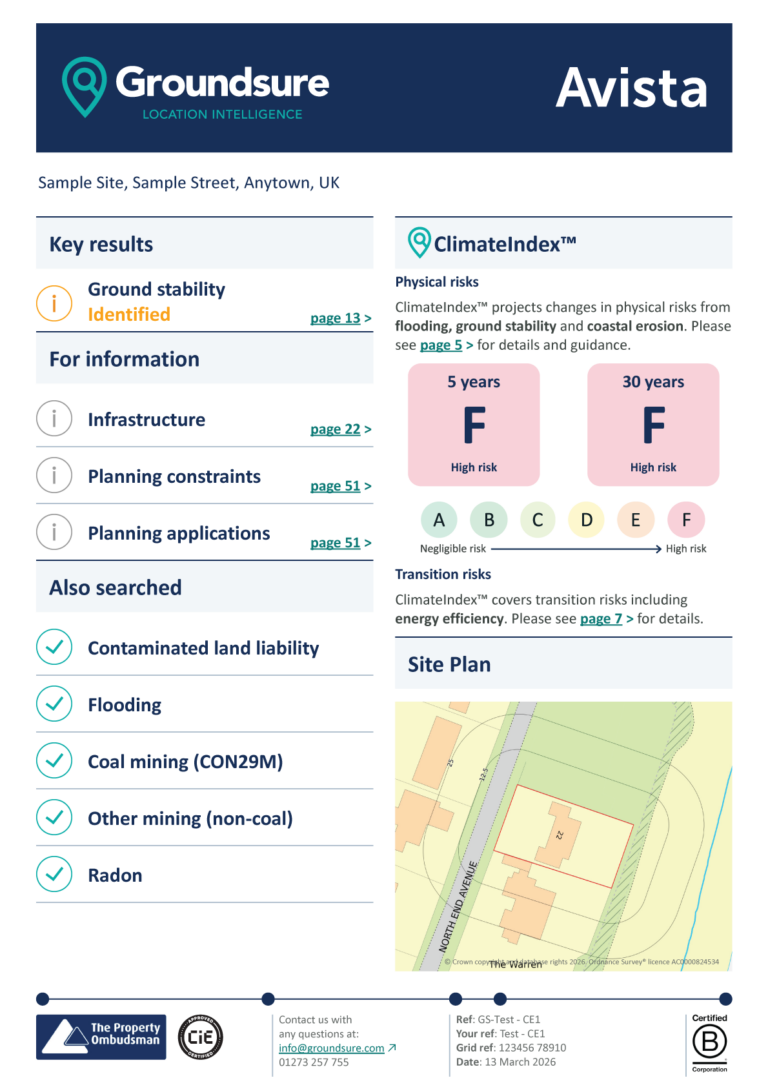
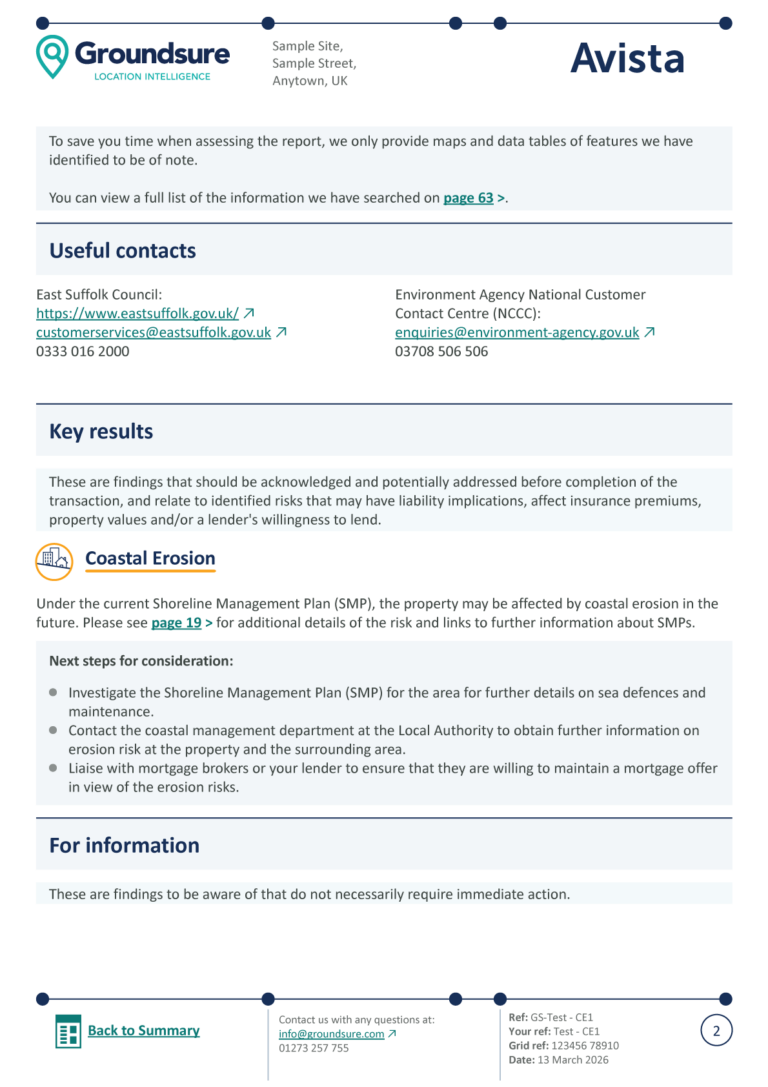
Below: Our Avista report on on a property in the north-end of Thorpness - which highlights the future physical risks in the short term.
Conclusion:
- Climate change is the most significant external impact that our towns and communities face today. Its scale, pace, and associated risks have far-reaching implications for property transactions, affecting not only individual assets but also wider infrastructure, investment portfolios, and lending decisions
- As environmental risks such as flooding, coastal erosion, and subsidence intensify, there is an increasing duty of care on property professionals to identify, assess, and communicate these risks clearly. Your clients are looking for you to guide them through it, and there’s a growing risk of litigation from failing to advise on climate risk
- Tools such as ClimateIndexTM provide valuable support and clarity, it allows you to give your clients the best advice around climate change and the risks to property transactions. It includes forward climate scenario modelling for key risks such as flooding, coastal erosion, subsidence, and it reduces potential ESG risks for your firm
- By leveraging solutions like ClimateIndexTM and Avista, property professionals can deliver more robust advice, safeguard their clients’ interests, and adapt to an increasingly climate-impacted future.
- By leveraging solutions like ClimateIndexTM and Avista, property professionals can deliver more robust advice, safeguard their clients’ interests, and adapt to an increasingly climate-impacted future.
Learn more about ClimateIndexTM here
Learn more about Avista here