Groundsure offers a comprehensive and compliant CON29M coal mining report for homebuyers and professionals alike. It’s powered by official Mining Remediation Authority (MRA) data, the National Geographical Database (NGD) and is supported by the Ordnance Survey (OS). A Mine Entry Interpretive Report (MEIR) is included in our CON29M report – as standard.
So, what is a Mine Entry Interpretive Report (MEIR)?
• A Mine Entry Interpretative Report (MEIR) provides expert analysis of known and/or suspected coal mine entries nearby a property
• The MEIR offers further details on the mine entry location, its depth, record accuracy and any previous treatment information – to help buyers and lenders make informed decisions about the potential issues posed by the recorded mine entries
• Historically, a MEIR report has been an additional (supplementary) report alongside a CON29M coal mining report
• Because when a CON29M identifies records of coal mine entries, shafts or adits, consumers can often be prompted to purchase an additional report – to provide further information on these mine entries.
Groundsure’s approach is different; we’re customer-focused
We’re always thinking about our customers – we take a user-experience approach when it comes to our product offerings. For many customers, when faced with the reality of an adverse CON29M, they typically would have to spend their time and money (on average £170) to purchase a separate MEIR.
This is combined with additional time and effort instructing solicitors, and waiting for the report to complete and be returned. We recognise this is an unnecessary process and not customer-focused. So, we introduced an integrated MEIR to our CON29M – now included as standard. Which saves customers both time and money.
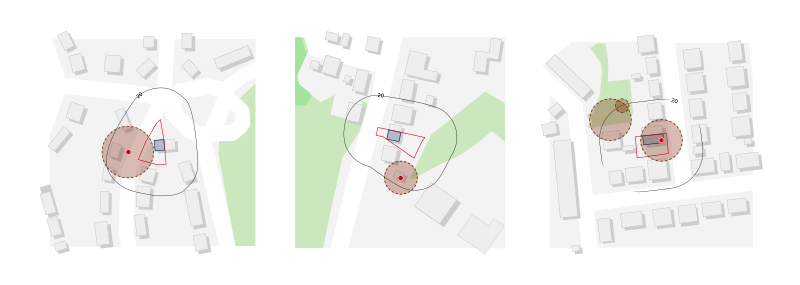
Below: An example of our CON29M with included Mine Entry Interpretative report.
For customers, the Groundsure CON29M means no hidden extras, no add-on fees, and no waiting around for supplementary reports.

Where mine entries are identified, your report will include:
• Highlighted MEIR risk section, when the property is within 20m of a recorded mine entry. This includes a map, risk statements and nest steps
• Two-fold definitive risk statements: risk to the main building, risk to rest of property
• Detailed map shows the digitised boundaries of the main building and rest of property, plotted mine entry and its zone of influence
• Identification of not just the risk posed by mine entries outside of 20m, but where the zone of influence impacts the property
• Building extents from Ordnance Survey’s National Geographical Database..
Discover what OS NGD data is and how we use it on our MEIR
The Ordnance Survey National Geographical Database (OS NGD) is a single, unified store of the Ordnance Survey’s authoritative data for Great Britain – it represents the country’s most advanced mapping dataset. It underpins the National Map, capturing over 600 million features of Britain’s landscape to enable joined-up, data-driven insights.
The OS NGD delivers rich, detailed data that Groundsure can leverage for improved analysis and reporting, which ultimately provides complete, per-building accuracy.
Crucially, by producing a built-in MEIR, it removes any barriers the customer may experience, such as having to manually order a separate report. The National Geographic Database generates data that maps the building outline. This means Groundsure can automatically distinguish between the built environment and any surrounding land and/or outside space that makes up the overall property.
This enables us to provide two separate risk ratings: one for the main building and one for the rest of the property. Lenders and potential home owners alike, want to be aware if an identified risk from a coal mine entry impacts the house itself, or even part of the wider property. This distinction can greatly impact insurability, mortgageability and can help a homeowner better understand the risk and how to deal with it going forward.
Key benefits of using OS NGD:
• NGD maps both buildings and structures within a site, alongside the site outline/boundary itself
• It provides clear mapping data – whereby any hazards can be referenced against the building outline, rather than the site boundary alone
• NGD presents reliable information; it helps ensure the risks flagged, are relevant to the building on-site, plus the broader site boundary.
The benefits to legal professionals and homeowners alike
For legal professionals relying on our CON29M, having an integrated MEIR enables clients to experience a smoother experience and upfront clarity in the reports. Any risk assessments are undertaken on a per-building basis, giving complete accuracy for your client’s needs. Additionally, you have the mutual benefit of no additional costs, and less time spent placing orders for supplementary reports.
For homeowners, it helps reduce the uncertainty and risk factors. In clear terms, it provides:
• Confirmation of mine entry locations and information relevant to you
• Expert interpretation of the data supplied
• Clear definitive risk statements
• Guidance and next steps
• No additional cost involved
• Faster turnaround time.
We’re backed up by our expert Mining Consultants
When working with Groundsure, legal professionals benefit from the support and guidance of our expert mining consultants, with over 40 years industry experience.
“We prioritise clarity, simplicity, and actionable results. We avoid jargon and technical language, ensuring findings are easy to understand for all who receive our reports. Our focus is on providing clear conclusions and practical recommendations, so customers can confidently make informed decisions about their property or project.”
Aaron Moyle – Environment & Geology Manager at Groundsure Discover how our CON29M can can enhance your property transactions – contact us on 01273 257755 or email us at: [email protected]