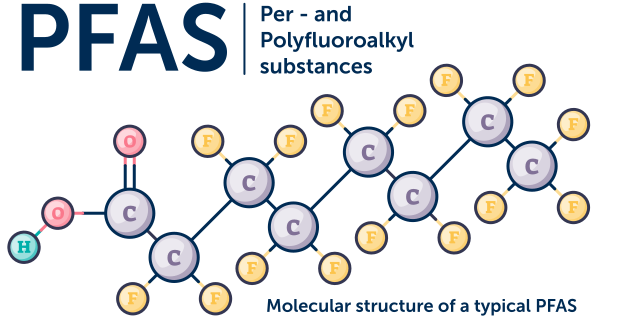
The term ‘PFAS’ is receiving increased attention everywhere; from local authorities, business and policymakers and increasing in the general public awareness.
Most recently, the UK government published its first comprehensive plan to reduce public and environmental exposure, signaling a shift towards more coordinated action.
PFAS: What are they?
Their full title is Per-and poly-fluroalkyl substances (PFAS), they are a large group of synthetic chemicals often referred to as “forever chemicals.” This nickname is rapidly gaining traction and fast becoming a key buzz word – not just within the building sector, but in everyday conversations. As the scale of the risk and liabilities associated with PFAS becomes more evident, industry regulators face increasing pressure to investigate and address associated contamination.
There’s growing evidence to suggest that (for the majority of PFAS) their widespread use poses risks to the environment, wildlife and human health. Emerging news suggests their presence has also identified PFAS on UK development sites, raising concerns across the property industry. PFAS resist being broken down within nature, meaning they can remain in the environment – such as soil, water, and living organisms for long periods. Some PFAS are known to ‘bioaccumulate’ in people, plants and animals over time.
PFAS: now a hot topic:
Because of this, they’re fast becoming one of the most talked about subjects. In recent months, there has been increasing media coverage and public awareness. They now represent one of the most pressing chemical challenges of our time. Why? Because PFAS are a group of synthetic man-made chemicals (over 14,000 man-made fluorine-containing compounds) which are valued for their unique properties such as heat-resistance, water and oil-resistant, their chemical stability, plus their resistance to degradation.
Due to these qualities, PFAS have been used extensively for decades in a wide-range of products from non-stick pans, domestic cleaning agents, cosmetics, waterproof clothing, industrial sites and fire-fighting foam. Following the extensive use of these substances over decades (along with their persistence character), it means they’re now widely detected in the environment around us and within the human body!
The regulatory landscape: how it’s shaping up
Regulation for PFAS is widely fragmented. The Environment Agency has conducted a PFAS Work Programme to develop a regulatory approach and prioritise resources to address related issues. For example, after identifying airports as a significant source due to their use of PFAS contained fire fighting foams, they have served Regulation 61 notices to request further information about the contents of the discharges through monitoring.
In February 2026, the UK’s Department for Environment, Food & Rural Affairs announced it had published its first ever national strategy to tackle and address these “forever chemical” substances. This signals that the government intends to be proactive in the regulation of PFAS, create new restrictions, update waste frameworks and more.
This cross-government, science-led strategy contains three pillars:

1). Understanding PFAS sources
2). Tackling PFAS pathways
3). Reducing the ongoing exposure to PFAS
- There are approximately 4,300 registered sites in the UK containing PFAS
- However, this statistic is likely to be closer to 10,000 according to media reports (1)
PFAS represents a defining environmental challenge, one that will continue to challenge us in years to come. Presumed PFAS sites include: airports; military land, fire stations, chemical sites, wastewater treatment plants, landfills, incinerators, and industries such as paint & ink manufacturing photography, textiles & leather, metal plating, paper & packaging, plastics, and automotive manufacturing.
Claire Petricca-Riding, Head of Planning & Environment Team at Irwin Mitchell said:“The Government’s PFAS Plan signals a decisive shift from passive monitoring to active management. It will have wide-ranging implications across the UK, spanning industry, infrastructure, water, waste, and land use. Organisations that engage early – by understanding their PFAS footprint, strengthening governance, and anticipating regulatory change – will be best placed to manage risk and remain resilient in an increasingly complex regulatory environment.”
The remediation of problem sites:
The remediation of high-risk PFAS-contaminated sites could prove extremely costly. Some estimates suggest that addressing the UK’s most severe PFAS “high risk”problem sites could reach up to £121 billion. To better understand and prioritise these risks, these sites are to be identified through a ‘PFAS Risk Screening Project’ – carried out by the Environment Agency (EA). This initiative includes a GIS-based tool designed to identify and prioritise sites with the greatest potential for environmental harm and risks due to PFAS contamination. The EA has highlighted three well-studied PFAS which are now heavily restricted under international law, these are: Perfluorooctane Sulfonic Acid (PFOS), Perfluorooctanoic Acid (PFOA) and Perfluorohexane Sulfonic Acid (PFHxS). Read the environmental risk evaluation PFAS reports here.
Historic landfills and PFAS:
Historic landfill sites are a major source of PFAS contamination. Many of these sites contain poorly documented, unsorted waste deposited in unlined pits – often below the water table – allowing contaminants to migrate into surrounding soil and groundwater. Across England and Wales there’s an estimated 21,000 historical landfills (2). In addition, the number of illegal waste sites continues to grow, further increasing the potential for PFAS to release into the environment.
The PFAS implications for development sites:
There’s still some uncertainty over the UK’s clean up plan – despite greater regulatory scrutiny over remediation strategies. So what is the best course of action when it comes to legal approach? Claire Petricca-Riding recommends that client warnings are given for presumed PFAS sites. She said: “This is because these are at a much higher risk from an environmental liability perspective, therefore firms should consider how these are treated going-forwards.”
She summarises key steps lawyers should consider:
- Did any previous environmental reports test for PFAS?
- Consider liability allocation in heads of departments/teams
- Is it possible to get insurance to cover PFAS contamination?
How Groundsure approaches PFAS in our reports:
Historically some airfields were omitted from mapping due to security sensitivities, (leading to censorship), while certain manufacturing activities previously identified in historic maps – such as fire foam and equipment works, are no longer specifically referenced. This can make it more difficult to pinpoint land uses that may have used PFAS-related substances.
To address this, when composing the contaminated land section of a Groundsure Review, our consultancy team will carefully inspect and interpret all available mapping alongside our extensive historical data library to build a comprehensive summary of the site history. As the understanding of PFAS-related liabilities continues to evolve, we will continue to refine our risk profiles and update our risk guidance accordingly.
Groundsure PFAS event
Join us on 25th June 2026 for the Groundsure PFAS Discussion 10:00am – 12:00pm.
We want to better understand how legal professionals and the wider property industry currently address PFAS considerations – and how they would like these issues to be managed during property transactions.
During the online session, we’ll explore topics including:
- How frequently does PFAS arise in your work?
- At what stage does PFAS become relevant during property transactions or site investigations?
- What are the current challenges, uncertainties or frustrations?
- Which types of transactions commonly encounter obstacles?
- What tools and data sources do you currently rely on?
- What could best practice look like moving-forward?
If you’d like to take part* contact us on: [email protected]
*Please note that spaces are limited; we’ll confirm your registration at the event via email.
(1) As included in an article published by The Guardian https://www.theguardian.com/environment/2025/jan/15/high-risk-sites-uk-forever-chemicals-hotspots-pfas The British Geological Survey published a report in July 2025 (2) https://post.parliament.uk/research-briefings/post-pn-0759/